Every country on Earth is in debt. The United States owes about $38 trillion. Japan owes around $9 trillion. Add up governments, companies, and households, and the entire planet sits on $315 trillion in obligations. That’s triple the size of the global economy.
Here’s where it gets strange. If everyone owes money, who’s on the receiving end? When you trace the chain of creditors upward, you eventually hit a wall. The world doesn’t owe money to a single group or secret entity. It owes money to itself. And that is exactly how the system was built.
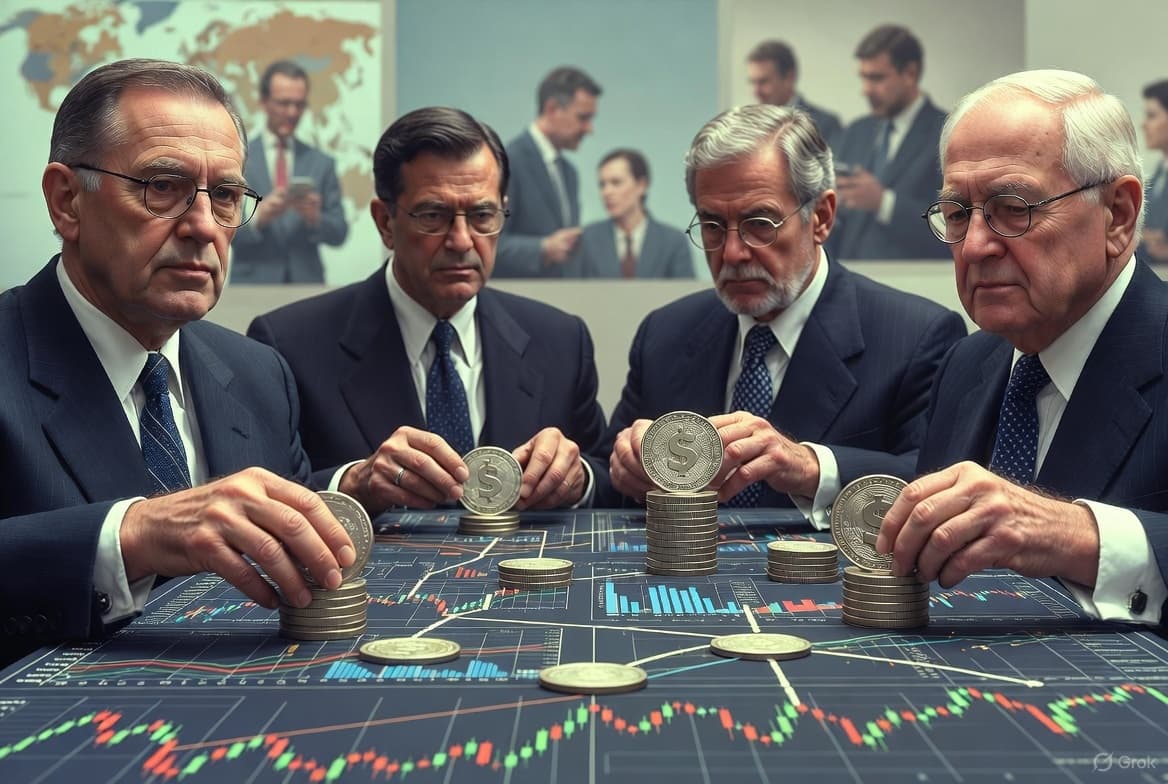
It wasn’t created overnight. It came together piece by piece over three centuries, shaped by four men who never met one another but each pushed the system in the same direction. They weren’t cartoon villains. They were bankers solving problems in ways that happened to benefit bankers. Their solutions stuck, spread, and eventually became the backbone of the modern financial world.
By the time their ideas fully matured, the world entered a trap with no exit: debt that never disappears, interest that never stops, and governments that can never walk away.
1. William Patterson: The Man Who Made Debt Permanent (1694)
Before 1694, kings borrowed the way anyone might borrow. They’d go to wealthy merchants, ask for a loan, and pay it back if they could. When they couldn’t, they defaulted. It was embarrassing, but it didn’t break the system. Debt came and went.
William Patterson changed that.
England was desperate for money to fight France. The treasury was empty. Traditional lenders wouldn’t touch the king because England had defaulted before. Patterson approached the crown with a radical offer: a group of merchants would lend the government £1.2 million—a huge sum at the time. In return, the government wouldn’t repay the principal at all. It would simply pay 8 percent interest every year, forever.
To manage this arrangement, Patterson proposed creating a new institution. The Bank of England.
Parliament agreed. The bank was chartered. The merchants handed over their gold. The government got its money. And the world gained a new idea: national debt as a permanent fixture.
What seemed like a technical fix was actually the invention of modern finance. The government’s IOU became an asset. The Bank of England could issue banknotes backed by this debt. In practical terms, government borrowing created new money.
The more the government borrowed, the more money the bank could print. The debt didn’t need to shrink. It didn’t even need to be repaid. It simply had to exist.
By the early 1700s, Europe had copied the model. A century later, Alexander Hamilton used the same structure for the United States. To this day, the British government has never paid off the debt it began accumulating in 1694. It has only refinanced, expanded, and continued paying interest.
2. Nathan Rothschild: The Man Who Made Debt Global (1815)
By the early 1800s, governments were borrowing enthusiastically, but the market itself was still clumsy. Each loan had to be negotiated individually. Interest rates varied wildly. Only the richest merchants could participate.
Nathan Rothschild industrialized the entire process.
With a network of family banks spread across five major cities, the Rothschilds could move money faster than any government. Nathan used that advantage to create the first modern international bond market. Instead of lending directly to a government, he bought government bonds at a discount and resold them to investors. That simple shift created liquidity. Suddenly, government debt wasn’t a private negotiation. It was a tradable product.
During the Napoleonic Wars, Rothschild’s information network gave him news of the Battle of Waterloo before Britain’s own government. He used the moment to buy low and sell high, earning a fortune. The larger impact was far greater than the money he made.
Before Rothschild, a default hurt one group of creditors. After Rothschild, a default could ripple across borders and ruin institutions throughout Europe. A British bond might sit in a German bank, which had used it as collateral for a loan to an Austrian investor, who sold it to a French pension fund. Default became something no government could risk. It wasn’t just bad economics. It threatened political and social stability across nations.
From that point forward, sovereign debt became something governments had to service continuously. Not because they were responsible. Because the alternative was a chain reaction no one could control.
Patterson made debt permanent.
Rothschild made it unavoidable.
3. J.P. Morgan: The Man Who Made Debt Infinite (1913)
By the early 1900s, the United States had become an industrial giant with a fragile banking system. There was no central coordinating authority. When a crisis hit in 1907, it was J.P. Morgan who stepped in personally. He locked New York’s most powerful bankers in his library and forced them to fund a rescue.
It worked. But Morgan understood the obvious problem. A country shouldn’t rely on a single elderly banker to prevent economic collapse. The system needed a permanent lender of last resort.
In 1910, Morgan’s closest allies and a handful of political figures gathered secretly on Jekyll Island to design the nation’s future monetary system. They did not call it a central bank because the public hated central banks. Instead, they created something that looked decentralized and democratic: the Federal Reserve System. Twelve regional banks. A governing board appointed partly by the president. A structure that appeared public but whose key components remained in private hands.
The Federal Reserve Act passed in 1913. Almost immediately, the government gained access to something no previous government had ever had: a buyer for its debt that could create money out of thin air.
If the government wanted to borrow, the Federal Reserve could simply buy the bonds. There was no longer a meaningful limit to how much debt the United States could accumulate. The market didn’t need to absorb all of it. The central bank could always step in.
With Morgan’s architecture in place, debt was no longer constrained by supply and demand. It could expand without limit.
4. Paul Volcker: The Man Who Made Debt Inescapable (1982)
By the 1970s, developing countries had borrowed heavily from Western banks. When Paul Volcker became chairman of the Federal Reserve in 1979, he faced out-of-control inflation and a collapsing dollar. His solution was brutal but effective: raise interest rates to levels no one had ever imagined. The federal funds rate hit 20 percent.
In the United States, inflation finally broke. In the developing world, something else broke.
Mexico, Brazil, Argentina, and many others saw their debt payments triple overnight. They couldn’t pay. A cascade of defaults threatened the entire global banking system.
Instead of allowing defaults, Volcker orchestrated a rescue through the IMF. The IMF didn’t bail out the countries. It bailed out the banks by lending the countries just enough money to keep their interest payments flowing. In exchange, nations had to accept harsh conditions: austerity, privatization, currency devaluation, and the surrender of key economic policies to outside institutions.
Nothing was solved. The debt wasn’t reduced. It was simply restructured and made permanent.
Volcker’s approach ensured that even when countries reached the breaking point, they stayed inside the system. No one was allowed to fall out of the debt cycle. The trap was complete.
The World Today
Combine the work of these four men and you get the modern financial world.
Patterson made sovereign debt permanent.
Rothschild made it globally interconnected.
Morgan made it limitless through central banks.
Volcker made it impossible to escape.
That is how the world ends up with $315 trillion in debt. None of it is meant to be repaid. All of it generates interest. And all of it is tied together so tightly that a major default anywhere threatens stability everywhere.
In the United States, about $1 trillion per year now goes to interest on federal debt. Most of it goes to institutions that manage money for the wealthy: investment firms, pension funds, insurance companies, banks. Taxpayers fund the interest. The owners of capital collect it. The principal remains untouched.
If the government tried to pay off the entire $38 trillion, the money supply would collapse. Modern money is created when the government borrows. Repaying the debt would destroy the very dollars people use to function. No one in government, and certainly no one in finance, wants that to happen.
The same dynamic exists in Europe, Japan, China, and everywhere else. Debt fuels the system. Interest feeds the people who manage it. And the cycle continues indefinitely.
The System We Live In
These four men didn’t work together. They lived in different centuries and faced different problems. But their solutions stacked neatly on top of each other. Bit by bit, the world moved toward a structure where:
- debt is permanent
- interest never stops
- governments can’t escape
- and the institutions that hold the debt always win
The $38 trillion owed by the United States isn’t a mistake. It’s not mismanagement or irresponsibility. It’s the system functioning exactly as designed.
If you understand that, you understand how power really works.