
The US struck Iran over the weekend and killed the Supreme Leader. Iran responded with missile and drone strikes on UAE and Saudi territory, hitting Jebel Ali port and Abu Dhabi infrastructure. Physical supply is already being disrupted, and oil markets closed Friday with Brent at $73/bbl, which almost certainly doesn't reflect what Monday morning looks like.
If you trade crude, products, LNG, or anything downstream of Middle East energy flows, here's what's actually moving.
Why the Strait of Hormuz Matters
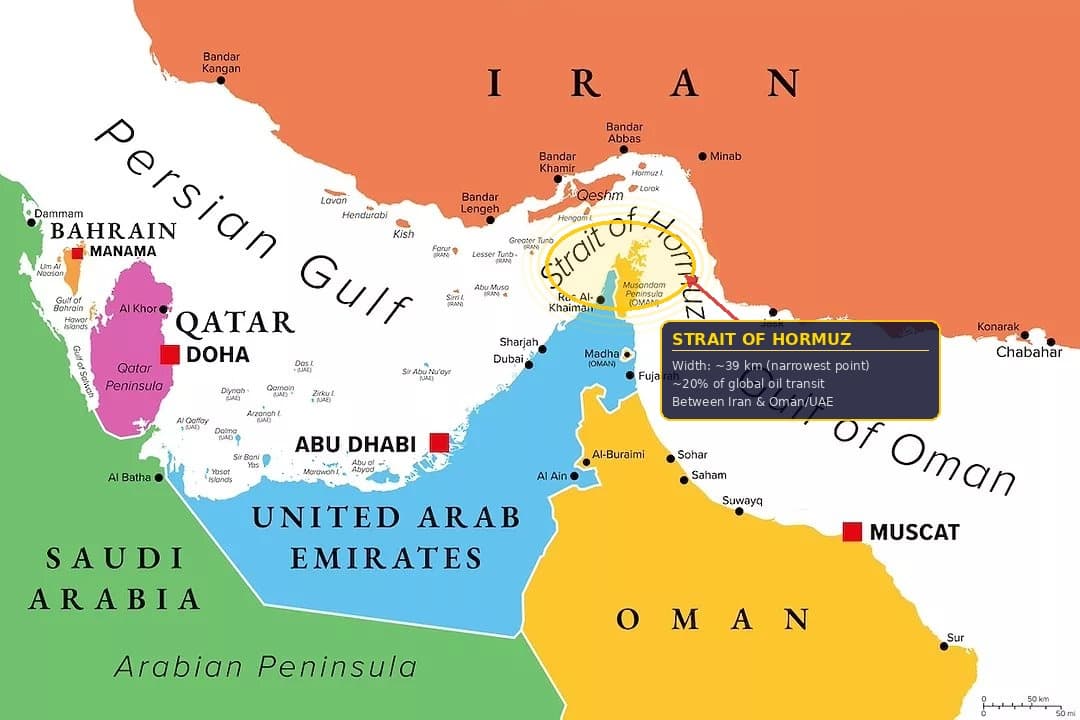
Roughly 30% of all seaborne crude passes through the Strait of Hormuz. For Asia that number is closer to 46% of total seaborne crude imports. India gets 85% of its LPG through that waterway. Qatar, which accounts for about 20% of global LNG supply, ships everything through it.
The Strait technically remains open. Vessel tracking shows some traffic still moving through, mostly Iranian and Chinese-flagged ships. But commercial operators, major oil companies, and insurers have pulled out. Insurance premiums were already at six-year highs before the strikes and they've gotten worse since. So what you've got is a waterway that nobody's physically blocking but that most of the global shipping community won't touch because the cost of insuring a transit has become prohibitive. The effect on cargo volumes is basically the same as a blockade.
The Oil Price Setup
Brent closed near $73 Friday. Analyst consensus is pointing to an $85-90 open Monday, with some scenarios putting the intraday high above $88. That's a 16-23% gap in a single weekend, which is big but probably not big enough if the conflict drags on.
Most people are holding onto the spike-and-retracement scenario. The majority view by end of week has Brent settling back into $70-80, which assumes some de-escalation or at least a pause in Iranian retaliation. That assumption carries real downside risk if Iran keeps hitting Gulf infrastructure.
A few things make this worse than the June 2025 episode. Iranian crude exports had already pre-surged to multi-year highs in February, which means those barrels have largely cleared physical storage and there's limited buffer available right now. Southern Iraqi production is already being curtailed, with reports of the Kormor field halting output. And Iran's response this time wasn't symbolic, it was planned and it's continuing.
On the WTI-Brent spread specifically, expect it to blow out. US producers will aggressively hedge by selling the back end of the WTI curve (Dec 26, Dec 27, Dec 28), which compresses WTI relative to Brent. At the same time, global refiners are bidding up Brent to cover their supply exposure and freight rate escalation adds another layer on top of that. The spread trade is probably the cleanest signal right now.
How Product Markets Are Reacting
Gasoil hits first. It's the primary fuel for military logistics, it's regionally concentrated, and there's basically no fast alternative supply. Gasoil cracks should gap sharply higher Monday.
Jet fuel follows with a slight lag but it'll probably be more persistent. Kuwait is a central hub for regional jet supply, and any sustained Strait disruption feeds directly into European aviation tightening. The market saw during June 2025 that jet cracks can stay elevated for weeks once a real shortage develops, and this time the physical situation is worse.
Gasoline is better insulated because global supply is more spread out and the trade routes are more flexible. It's not immune but it's not the immediate pressure point either.
For product traders, Indian refinery exports from Jamnagar are worth watching. Jamnagar's already established itself as the go-to for clearing European jet demand and it's the most realistic alternative supply source available right now.

What OPEC Can and Can't Do
OPEC Plus approved a production increase of 206,000 barrels per day at their last meeting, which surprised analysts expecting a bigger number. The logic makes sense even if the size was underwhelming. The group holds about 3.5 million b/d of spare capacity, but that capacity sits mostly in Saudi Arabia and the UAE, both of which are absorbing Iranian missile strikes right now. Dumping large volumes prematurely would leave them with nothing in reserve if things get worse, so they're holding back and waiting to see how bad the disruption actually gets.
There's a bigger problem too. A lot of that Gulf spare capacity can't reach global markets if the Strait stays effectively closed. Saudi Arabia's East-West Pipeline (capacity around 7 million b/d) and the UAE's Fujairah pipeline offer partial alternatives, but terminal infrastructure at Jeddah limits how much actually gets through. These routes could handle some displaced volume but they don't come close to replacing a full Strait closure.
Russia Gets Stronger
India and China are the dominant buyers of crude that transits the Strait, and both now have good reasons to lean harder on Russian supply. India's the most exposed right now and will probably pivot toward Russian crude quickly since the logistics are already set up. China had been moderating its Russian crude purchases recently but that restraint probably doesn't survive if this conflict goes beyond a few weeks.
China also built up significant strategic crude reserves during the global oversupply period, which gives it a short-term cushion and potentially positions Beijing to re-export to third markets if the supply crunch gets bad enough.
LNG Is Getting Overlooked
LNG hasn't gotten as much attention as crude and products, but it should. Israel has curtailed production from its offshore fields. Energy tankers are already disrupted in the Gulf. Qatar exports about 20% of the world's LNG and every cargo has to go through the Strait, which makes it just as exposed as crude even though the headlines haven't caught up yet.
The JKM-TTF spread (that's the Asia-Europe LNG price gap) should widen as Asian buyers compete for whatever alternative supply they can find. US LNG export infrastructure is already running near capacity so American exporters can't meaningfully fill the gap even if the economics are screaming at them to.
What Determines How This Plays Out
First, whether Iran's willing to negotiate. Iran's governance doesn't collapse when you remove one leader because the system is built with layers of redundancy, so military pressure alone probably doesn't resolve this quickly.
Second, how well Gulf infrastructure holds up. If Iranian strikes hit something like Ras Tanura or cause serious damage beyond what's already happened at Jebel Ali, the supply impact would be immediate and severe. That's still a low-probability outcome but it's a live one.
Third, how much economic pain the administration can tolerate. Brent sustained above $90 for a week or two would be a real headwind to domestic economic messaging, and the same political sensitivity that drove rapid tariff adjustments earlier this year could push the administration to change course if prices stay high long enough.
Most people are expecting a conflict that lasts at least a week with partial de-escalation through diplomacy. The worst case, a sustained Strait closure where Iran goes after major Gulf infrastructure, is unlikely but there's no combination of OPEC spare capacity, strategic reserves, and alternative pipeline routes that could actually offset it. That's what makes this different from a normal geopolitical flare-up, the downside scenario doesn't have a clean fix.