Does your pay seem to disappear every month, as if it has an allergy to your bank account? You get paid, blink, and all of a sudden you're counting down the days until your next payday. Everybody has been there. But what if you could stop that loop by carefully and purposefully managing what you currently have, rather than by making more money (though that never hurts)?
That is precisely the purpose of this recommendation. Without the guilt, guesswork, or spreadsheets that make conventional budgeting systems seem like a burden, this contemporary framework for money management lets you strike a balance between today's requirements and tomorrow's goals.
Portfolio Building Recommendation: The Split That Balances Stability and Growth
The traditional 50/30/20 rule (50% for needs, 30% for wants, and 20% for savings) was, let's face it, a good place to start. However, that norm originated in a world before finance and cryptocurrency. "Savings" meant a dusty bank account with 0.01% interest back then. These days, we have affordable trading platforms, decentralised finance, and tax-advantaged accounts.
We have thus redesigned the business for a generation that is eager for financial independence, internationally connected, and digital first.
This suggestion is fundamentally based on three pillars:
- Expenses are what keep your life going.
- When life throws you a curveball, security is your safety net.
- Growth is your long-term wealth engine.
Let's dissect it now.
Portfolio Building Recommendation: The Split That Balances Stability and Growth
Prior to the digital age, our parents used to advise dividing your income into three categories: 20% for savings, 30% for wants, and 50% for monthly costs. With increased access to cryptocurrency exchanges, trading platforms, and investment opportunities in the digital age, this is a fresh suggestion for splitting your monthly income.
Keep in mind that this varies on your age, family circumstances, present income, and other commitments and priorities. Although it may not directly apply to you, it would still be helpful to heed this advice:
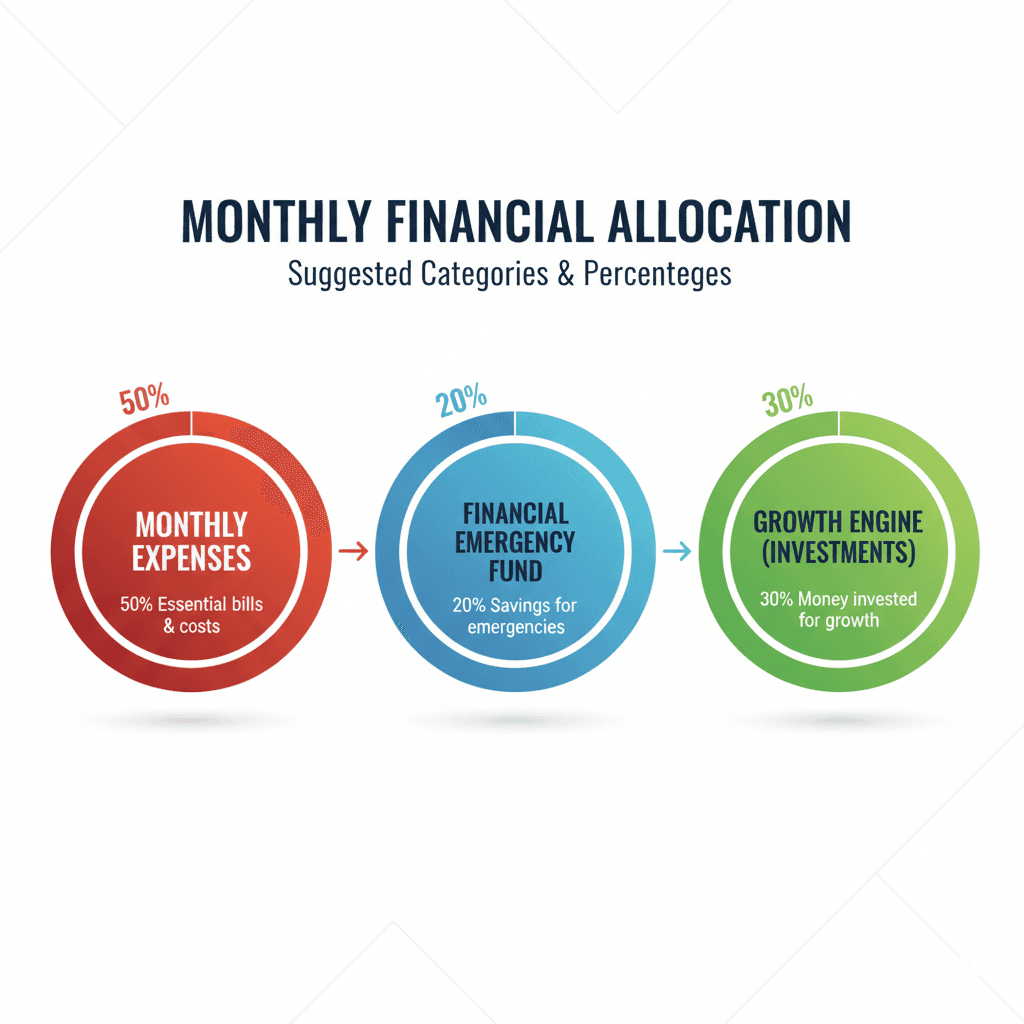
The following is a decent method to split your income:
50% – Monthly Expenses
20% – Your Financial Emergency Fund
30% – Your Growth Engine (Investments)
Simple, right? But the magic lies in how each piece works together. We will explain a bit more about these percentages.
Divvying Up Your Paycheck
50% – Monthly Expenses: Essentials and Mindful Living
The necessities like rent, groceries, utilities, transportation, and the odd cup of coffee that keeps you sane accounts for half of your income. The catch is that survival isn't the only goal here. It has to do with careful spending.
Consider this category to be the cornerstone of your stability. The objective is to ensure that every yen, dollar, or pound you spend genuinely improves your quality of life rather than eliminating everything enjoyable from your life.
Pro tip: Automate your bills and recurring expenses. When your essentials are on autopilot, you gain a clearer picture of what’s truly left for growth and security.
20% – Emergency Fund
This would be your shock absorber if your financial life were an automobile.
Unexpected medical costs, career changes, or the moment your laptop chose to retire early are all smoothed out by it.
This money cannot be negotiated. I've witnessed several clients neglect their emergency fund, only to come to understand its significance when things go wrong. Maintaining liquidity, minimal risk, and tax efficiency is crucial.
This is where things get interesting: you can make this money work a bit harder by using tax-advantaged accounts rather than putting it in a regular savings account, where it silently loses value due to inflation.
- The NISA (Nippon Individual Savings Account) is your first choice in Japan. It provides tax-free investment, which eliminates taxes from your returns which is a significant benefit when compounding over time.
- The Roth IRA has a comparable function in the United States. Your assets grow tax-free when you make post-tax contributions. Your donations can be withdrawn at any time without incurring penalties.
- The Individual Savings Account, or ISA, is your closest buddy in the UK. It protects your profits from taxes so your emergency fund may grow silently.
The idea isn’t to take big risks here. You’re not chasing high returns; you’re optimizing safety with a touch of efficiency. Think short-term bonds, money market funds, or low-volatility ETFs within these accounts.
Your emergency fund should be like a well-tuned umbrella, ready when the storm hits, but not costing you anything while it sits in the corner.
30% – Your Growth Engine (Investments)
This is the point at which your money begins to work harder. Your long-term wealth builder, the Growth Engine, is what turns financial stability into financial independence.
Growth, however, does not entail "throwing everything into cryptocurrency and hoping for the moon." It's all about structural diversification, or distributing your money among several vehicles that work well together.
We divided that 30% as follows:
- 15% The Foundation (Investments in Dividends)
- 10%: The Accelerator (Staking & Crypto)
- 5%: The Trading Tactical Advantage. So TrendRider
Let's examine these:
Your Growth Engine (Investments)
The Foundation (15%): Dividend Investing
Investing in dividends is a quiet yet effective approach to accumulate money. As a shareholder, you accumulate a portfolio of stocks that pay you dividends on a regular basis.
Consider it like growing fruit plants. They yield a consistent crop when you commit time and money up front. The objective is to allow your profits to produce additional earnings over time rather than to get wealthy suddenly.
We've seen people who began with a small monthly income and eventually had enough dividend income to cover significant costs like rent. This is compounding's power.
Later on, we'll discuss how to choose these stocks in greater detail, but for now, keep in mind that consistency and early start are crucial.
The Accelerator (10%): Crypto & Staking
This is the part that starts heated conversations. Beyond the "get rich quick" headlines, cryptocurrency has developed. It may be a real growth booster in your portfolio if you handle it wisely.
The secret? Pay attention to staking, which is the act of securing your cryptocurrency holdings in order to facilitate network operations and generate rewards. In the digital realm, it is comparable to earning interest.
Naturally, cryptocurrency is riskier and more volatile. However, you may expose yourself to innovation and perhaps outsize profits without endangering your entire strategy by allocating a regulated portion which is just 10%.
Recall that gambling is not the objective. It is to engage in the rapidly changing digital economy in a wise manner. Just keep your Crypto Staking and don’t be concerned when it goes down. Don’t panic.
There is a rule of thumb where experts recommend having at least 0.1 Bitcoin’s. And just leave it staking. We also recommend learning more about the crypto space and maybe avoid meme coins.
The Tactical Edge (5%): Trading
This is for the active investors who want to understand market patterns, analyze charts, and take calculated risks. Although it may be thrilling and successful, trading is not for everyone.
And Trendrider is more concerned with this. And this is why we exist to make better and simpler for you.
More information on using the Trendrider indicators will be posted, and training materials will be created.