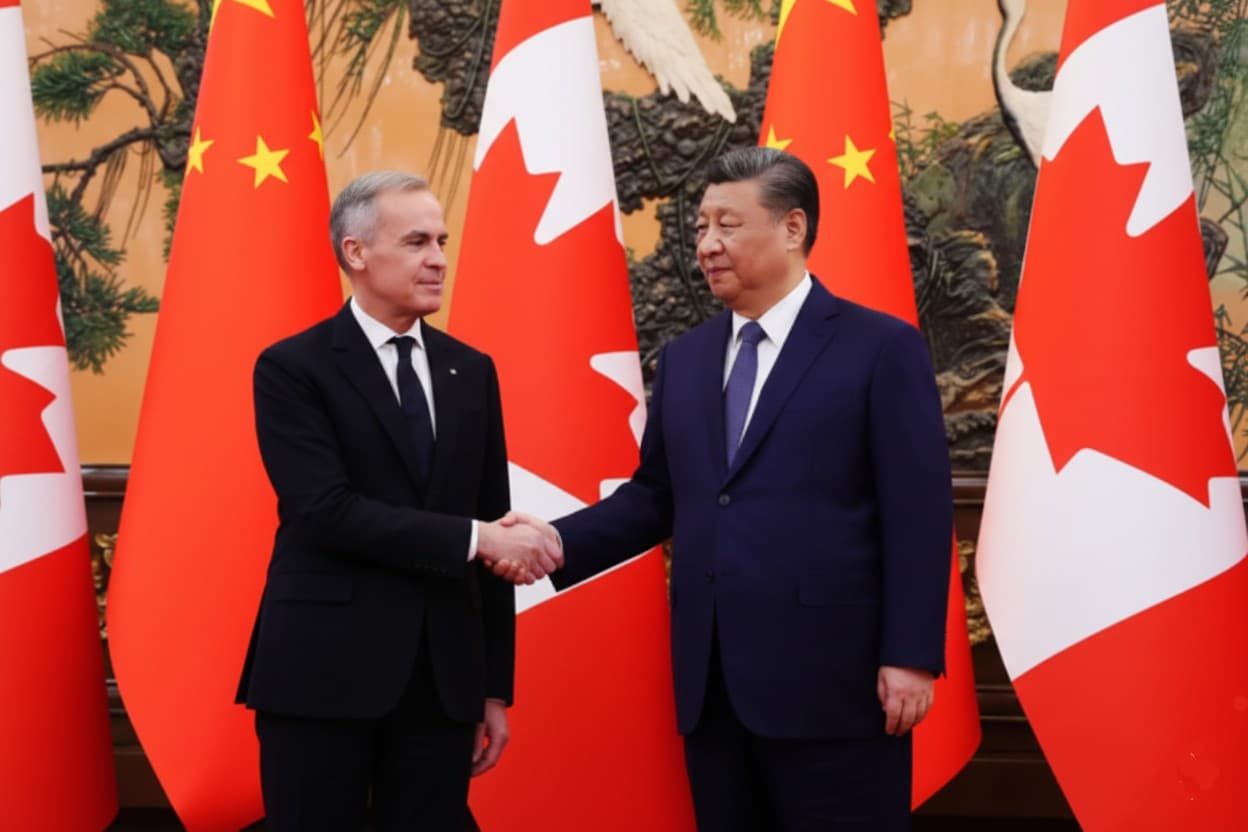
Mark Carney just flew to Beijing and shook hands with Xi Jinping, and after eight years of diplomatic freeze between Canada and China, he's calling it a "strategic partnership." This happened January 16, 2026.
Why now? Because Trump's tariffs basically forced his hand. About 75% of Canadian manufactured exports go to the U.S., and when Washington slapped tariffs on steel, aluminum, vehicles, and lumber, Canada needed another buyer fast. China was the obvious choice, even if the politics are messy.
For anyone trading Canadian commodity stocks, this deal touches agriculture, energy, and fertilizer directly. There's real money moving here.
The Deal Itself
Canada expects that canola meal, lobsters, crabs, and peas won't face anti-discrimination tariffs starting March 1, 2026, at least through the end of the year. That's nearly $3 billion in export orders that just got unlocked.
China's already Canada's second-largest trading partner at $118.7 billion in two-way trade, but exports to China dropped more than 10% last year because of the tariff war. Carney wants to increase exports to China by 50% by 2030, which is aggressive but that's the target he's set.
And here's the part that really signals a shift: Canada will allow up to 49,000 Chinese electric vehicles into its market at just 6% tariffs, compared to the 100% levy Ottawa imposed a few months ago. That's a complete reversal from the U.S.-aligned approach Canada was taking.
Canola and Fertilizer
Canola's the clearest winner. China had a 75.8% tariff on canola seeds that effectively shut Canadian producers out of a massive market, and that's about to change.
Richardson International and Viterra (now part of Bunge Limited, NYSE: BG) dominate Canadian canola. Both got banned from shipping to China for three years after the Huawei executive arrest, but both are now listed as approved exporters on the Chinese General Administration of Customs website.
The publicly tradable angle here is Nutrien Ltd. (TSX: NTR, NYSE: NTR). They're the world's largest fertilizer producer, specializing in potash, nitrogen, and phosphate, and Canadian canola farmers need fertilizer. If farmers are planting more canola to meet Chinese demand, Nutrien benefits directly.
Nutrien's the largest potash producer globally, second largest in nitrogen fertilizer, and they already produce about 27 million tonnes of crop nutrients annually. China's also dealing with restricted fertilizer imports because of sanctions on Russia and Belarus, two of the world's largest potash producers, so if Canada ramps up agricultural production for Chinese markets, Nutrien's products become essential inputs.
The stock trades on both exchanges and the company recently reported strong demand in China, Brazil, and Southeast Asia. Worth watching.

Energy Is Murkier
The energy side is less clear. Canada signed a memorandum on clean and conventional energy cooperation, but China didn't actually commit to buying more Canadian petroleum or LNG. So it's more of a handshake than a contract.
That said, two names keep coming up: Suncor Energy Inc. (TSX: SU, NYSE: SU) and Cenovus Energy Inc. (TSX: CVE, NYSE: CVE).
Rongsheng is China's largest independent refiner with capacity of 40 million metric tons a year, which works out to about 800,000 barrels a day, and they've become a regular buyer of heavy sour Canadian crude since the Trans-Mountain pipeline expansion started operations last May. Rongsheng already buys from both Cenovus and Suncor, and if Carney's partnership reduces trade friction, more Canadian oil flows to Chinese refineries.
The risk is that Trump's moves on Venezuelan oil could flood the market with competing heavy crude. Canadian producers have pipeline advantages to U.S. Midwest refineries, but Chinese buyers have options and they'll go wherever the price is right.
What China Gets
Chinese companies get access to Canadian natural resources at reduced tariffs, which is the whole point from their side.
Food processors get cheaper canola oil, lobster, crab, pork, and seafood. EV manufacturers like BYD and Geely can now export up to 49,000 vehicles to Canada at 6% instead of 100%, which gives them a foothold in North America. The partnership emphasizes two-way investment in clean energy, wood products, and technology, so Chinese companies looking to invest in Canadian resources will have an easier time. And while there's no binding LNG agreement yet, Chinese energy companies are positioned to secure long-term supply deals as Canada builds out export capacity.
What Could Go Wrong
Three things to watch.
Trump's response is the big one. The U.S. dominates Canadian trade and if Trump retaliates against Canada for breaking with U.S. China policy, Canadian companies could face even worse tariffs. The Trans-Mountain pipeline helps diversify away from U.S. dependence, but Canada still needs American market access for a lot of its exports.
Political stability is another question mark. Carney called China Canada's biggest security threat during his campaign last year, and now he's calling it a strategic partner. That's a sharp pivot, Canadian politics are volatile, and if Carney loses power the whole deal could unwind pretty quickly.
And then there's execution risk. Agreements are just paper until actual trade flows happen. The key date is March 1, 2026, when canola tariffs are supposed to drop. If volumes don't materialize after that, these stocks won't move.
The Setup
Nutrien has the clearest path to benefit from increased agricultural trade. Suncor and Cenovus have potential upside if energy cooperation deepens, but they're facing headwinds from competing supply.
On the Chinese side, watch for food processors, EV manufacturers, and energy companies announcing Canadian partnerships or investments over the coming months.
This setup works if Carney can actually deliver the export growth. If Canadian companies start shipping significantly more canola, seafood, and energy products to China by mid-2026, these stocks should reflect it. But if Trump escalates or Chinese buyers don't follow through, the trade falls apart.
Watch the volume data from March onwards. Don't bet on geopolitical promises until you see actual cargo ships moving.