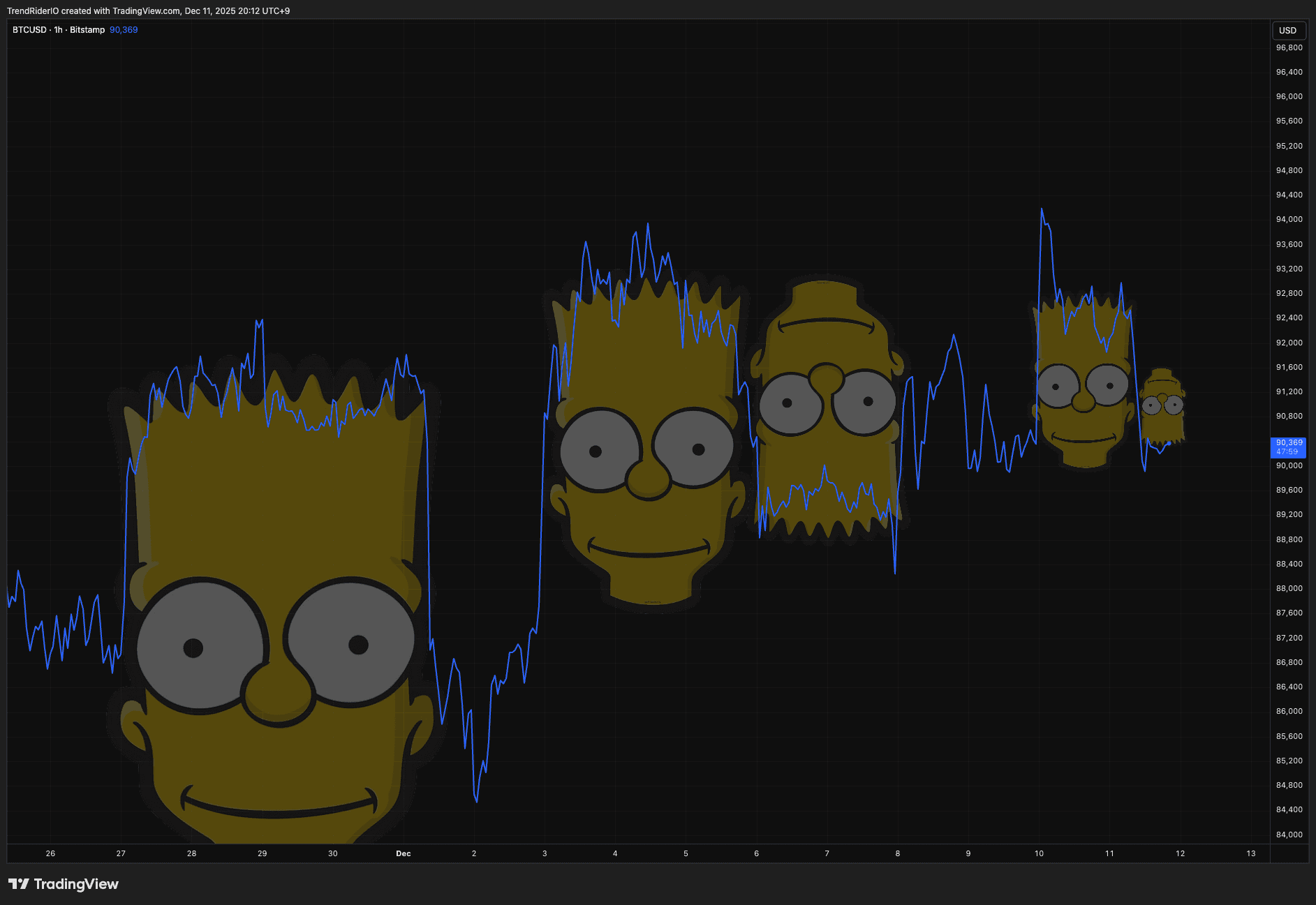
Every so often, crypto Twitter creates something that perfectly captures a market phenomenon. The "Bart pattern" is one of those rare moments where internet humor and technical analysis collide. If you've spent any time watching $BTC on lower timeframes, you've probably seen this cartoon character staring back at you from the charts.
The Bart pattern gets its name from Bart Simpson's distinctive spiky hair. On a price chart, it looks exactly like his head: a sharp vertical move (the face), a flat consolidation period (the top of his head), and then a sharp reversal back to where price started (completing the silhouette).
There are two versions. The bearish Bart shows price spiking up, consolidating sideways, then crashing back down. The bullish or inverse Bart does the opposite: price drops sharply, consolidates, then recovers to its starting point.
The pattern first gained widespread attention during the 2018 bear market when trader "The Crypto Dog" popularized the term on Twitter. As liquidity dried up and trading volumes collapsed, these formations started appearing everywhere on Bitcoin charts. Traders quickly turned it into a meme, but the underlying mechanics are worth understanding.
Bart patterns aren't random. They typically emerge under specific market conditions.
Low Liquidity Environments
When trading volume thins out, it takes less capital to move price significantly. A single large order can create that initial spike. Once the move stalls and price consolidates, there's often not enough new buying or selling interest to sustain the new level. Price eventually reverts.
Margin Liquidations
This is the more cynical explanation, and it's probably closer to reality. Crypto markets have historically been playground for leveraged trading. When enough traders pile into one direction, a large player can push price against them, trigger liquidations, and then let price return to equilibrium.
Think about it: if there's a cluster of long liquidations sitting just below current price, a well-capitalized trader can profit by shorting, pushing price down to trigger those liquidations, then closing their position as the cascade of forced selling does the work for them. The reverse works for short squeezes.
Market Structure Reactions
Sometimes Bart patterns are simply the market testing a level and rejecting it. Price probes higher, finds no follow-through, and returns to the previous range. Not every Bart is manipulation. Some are just how markets discover price.
Reading Bart Patterns on Your Charts
Spotting a Bart pattern in hindsight is easy. Trading it in real-time is harder because you never know if the consolidation will break out or break down until it happens.
The Anatomy
A complete Bart pattern has three parts:
The first is the initial spike. This is a sudden, sharp move in one direction. On lower timeframes like the 1-hour chart, this often happens within just a few candles. The move typically occurs during low-volume periods or on surprising news.
The second is the consolidation range. After the spike, price trades sideways in a relatively tight range. This forms the flat top of Bart's head. The longer this consolidation lasts, the more traders become convinced the new price level will hold.
The third is the reversal. Price then moves sharply in the opposite direction, often retracing most or all of the initial move. This completes the pattern and leaves a distinctive shape on the chart.
What the Pattern Tells You
A completed Bart pattern suggests the initial move lacked conviction. Whether it was manipulation, a failed breakout attempt, or simply a liquidity grab, the market ultimately rejected that price level.
For traders, this offers a few insights. First, be cautious of sudden moves on low volume. They're more likely to reverse. Second, if you're caught on the wrong side of a spike, waiting out the consolidation might be smarter than panic-selling. Third, these patterns tend to cluster during specific market conditions. When you see one Bart, expect more.
The Connection to Classical Analysis
Here's where it gets interesting. While crypto traders invented the meme, the underlying concept isn't new. Richard Wyckoff described similar price behavior over a century ago.
In Wyckoff's framework, large operators (he called them the "composite man") move price to accumulate or distribute positions. They shake out weak hands with sudden moves, accumulate during the consolidation, then allow price to move in its natural direction.
The Bart pattern, viewed through this lens, is essentially a modern visualization of short-term accumulation or distribution. The spike creates panic or excitement among retail traders. The consolidation allows larger players to build positions against the crowd. The reversal is the market revealing its true direction.
This doesn't mean every Bart is institutional manipulation. But understanding that large players operate differently than retail traders helps explain why these patterns occur so frequently in markets with concentrated liquidity.
Practical Considerations
If you're trading crypto, especially on lower timeframes, you'll encounter Bart patterns regularly. Here's how to think about them.
Don't Chase Spikes
The first move of a potential Bart pattern is the worst time to enter. You're buying the top of a move that may immediately reverse. If you missed the initial move, wait. Watch how price behaves during the consolidation before committing capital.
Watch for Volume Confirmation
Legitimate breakouts typically come with increasing volume. Bart patterns often show a spike in volume on the initial move, then declining volume during consolidation, then another spike on the reversal. If you see this volume signature developing, be cautious about the sustainability of the move.
Consider the Broader Context
A Bart pattern at a significant support or resistance level tells you something different than one occurring in the middle of a range. If price spikes into a major resistance zone and then forms a Bart, that's valuable information about where sellers are willing to step in.
Manage Your Leverage
Bart patterns exist because leveraged traders get liquidated. If you're using leverage, make sure your position size and stop placement account for the possibility of sudden, violent moves in either direction. The "right" trade can still lose money if you're sized incorrectly.
The Meme Is the Message
There's something fitting about a cartoon character becoming a technical analysis tool. Crypto markets have always blended irreverence with genuine financial innovation. The Bart pattern captures this perfectly: it's simultaneously a joke and a legitimate market phenomenon.
The next time you see Bart's spiky head on your charts, remember what it represents. Markets are a constant battle between different participants with different information, different time horizons, and different goals. Bart patterns are just one way that battle plays out visually.
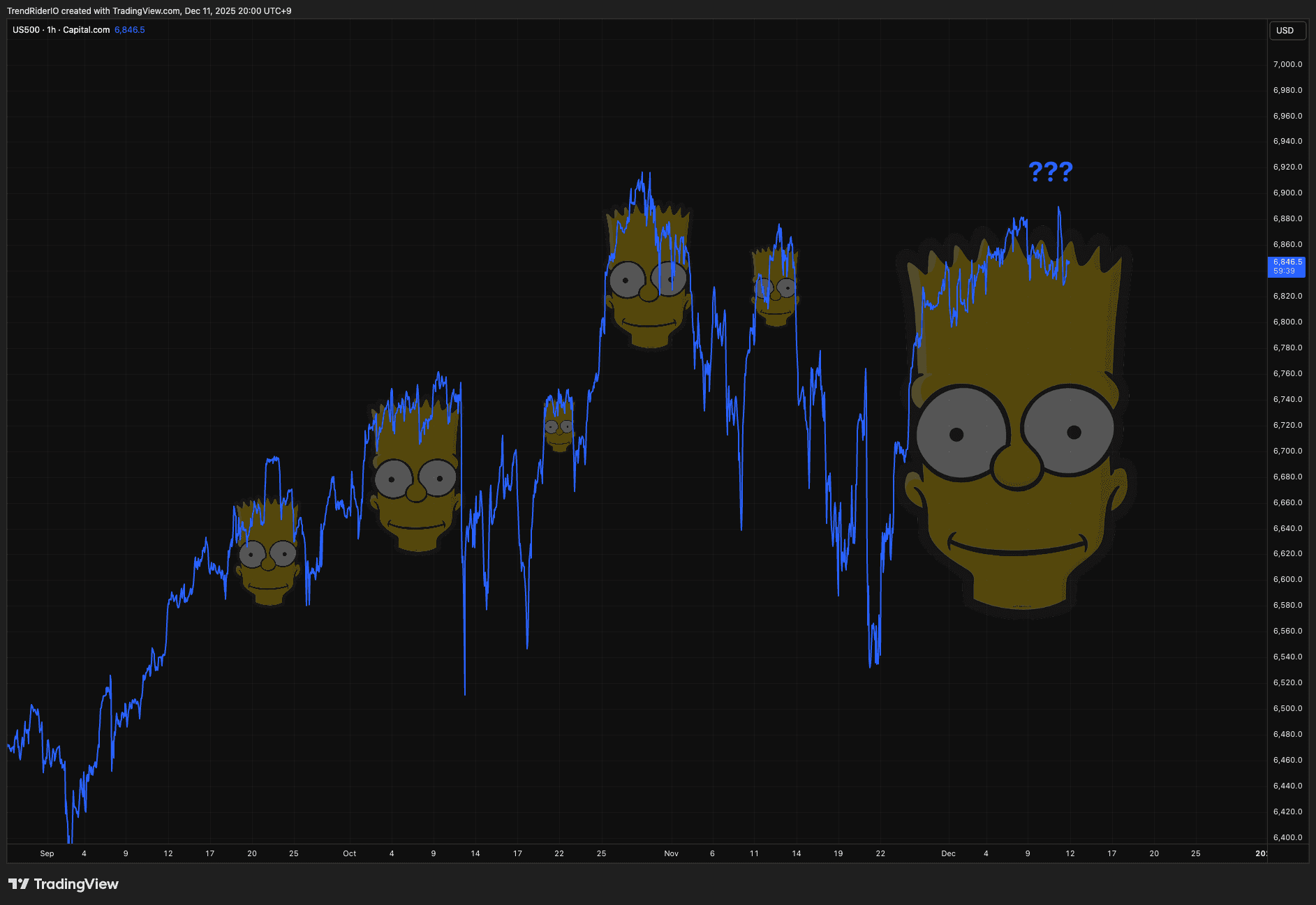
Is there another bart in progress?
Spotted any good Barts lately? We'd love to see them.
Join our Discord and share your charts. Tell us if you've noticed similar patterns on other pairs or timeframes. Let's figure this out together.
Click the Discord button anywhere on our site to join the conversation, or use this link.
You can also follow us on X where we post charts like this one.